How to Sell Event Tickets Online in Nigeria in 2026 (Complete Step-by-Step Guide)
April 21, 2026 • 1,777 views
How to Sell Event Tickets Online in Nigeria in 2026 (Complete Step-by-Step Guide)
You've planned the venue. You've booked the speakers. You've confirmed the caterer. But if people can't find your event online or buy a ticket in 30 seconds, the hall will be half-empty — and it won't be because the event wasn't good enough.
Digital ticketing has quietly become the difference between sold-out events and struggling ones across Nigeria. Research consistently shows that events using online ticketing platforms sell significantly more tickets than those relying only on gate sales or informal transfers. The reason is simple: when buying a ticket requires a bank transfer to a personal account, a screenshot, and a follow-up message — most people don't bother. But when it takes 30 seconds and two taps, they do it immediately.
Whether you're organising a concert in Lagos, a tech summit in Abuja, a church revival in Enugu, or a corporate dinner in Port Harcourt, this guide will walk you through exactly how to sell your event tickets online in Nigeria in 2026 — step by step.
Why Online Ticketing Is No Longer Optional for Nigerian Event Organizers
Three years ago, collecting tickets at the gate or through WhatsApp bank transfers felt like the normal way to run events in Nigeria. Today, that approach costs organizers money in three specific ways.
First, it kills impulse purchases. When someone sees your event on Instagram at 11pm and feels excited, a digital ticket platform lets them buy that ticket in the next two minutes. If they have to wait until morning to send a transfer and then message someone for confirmation, the excitement fades and the ticket never gets bought.
Second, it destroys your data. Without digital ticketing, you have no attendee list, no email addresses, no way to reach your audience for your next event. You're starting from zero every single time.
Third, it limits your reach. Someone in Abuja cannot easily buy a ticket to your Lagos event through a gate or a personal bank account. Online ticketing makes your event nationally — and even internationally — accessible.
The shift has happened. Nigerian attendees, especially those under 40, now expect to find, pay for, and receive event tickets entirely on their phones. The question is no longer whether to go digital. It's which platform to use and how to set it up correctly.
Step 1 — Choose the Right Event Ticketing Platform in Nigeria
Not all ticketing platforms are built for the Nigerian market. Some charge commissions that eat into your revenue before you've covered your costs. Others are designed for international audiences and struggle with local payment methods. A few don't even offer an event discovery audience — meaning once you list your event, you're still entirely responsible for sending everyone to the link yourself.
Here is what to look for when choosing a platform:
Zero or low commission. Every percentage charged per ticket is money coming out of your event budget. On a 500-ticket event at NGN 10,000 per ticket, a 10% commission costs you NGN 500,000. That is a significant vendor or production cost handed directly to the platform.
Local payment support. Your attendees need to pay in Naira through cards, bank transfers, or USSD. International payment processors are not the right fit for most Nigerian audiences.
Built-in event discovery. The platform should have its own audience of people browsing for events — not just a tool to sell tickets to people you've already reached yourself.
Vendor marketplace access. The best platforms connect you not just to ticket buyers but to photographers, caterers, DJs, decorators, and security — everything you need to run the event itself.
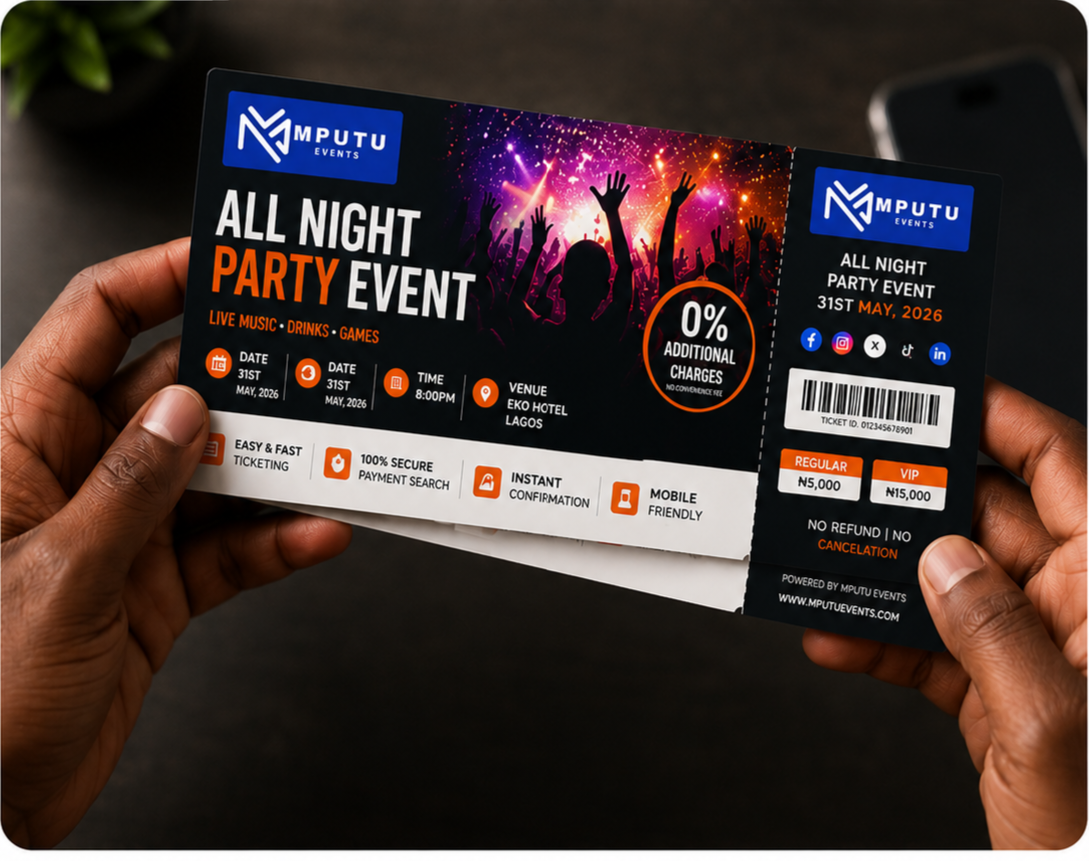
MputuEvents is currently the only platform in Nigeria that offers all four. It operates a 0% commission model for early adopters — meaning you keep every naira from your ticket sales. It supports Naira payments, has a growing discovery audience across Nigeria, Ghana, South Africa, Cameroon, the UAE, and the US, and hosts a full vendor marketplace with over nine categories of event service providers.
You can view the full listing options and pricing at mputuevents.com/pricing.
Step 2 — Create Your Event Listing
Once you've chosen your platform, your listing page is the most important thing you'll build for your event. A poorly written listing with a bad photo will kill your ticket sales even if your promotion is excellent. A strong listing converts browsers into buyers.
Write a title that is clear and specific. Avoid vague titles like "A Night to Remember." Instead: "The Lagos Startup Networking Dinner — May 2026" or "Kingdom Revival Conference — Abuja 2026." Your title should tell someone exactly what the event is in one line.
Write a description that sells the experience, not just the logistics. Most organizers list the date, venue, and agenda — and stop there. That is the minimum. What you need to include is the transformation: what will attendees feel, learn, experience, or gain by attending? Address the question every potential attendee is asking: why should I spend my time and money on this specific event?
A strong description structure looks like this:
- Opening line that captures the energy or promise of the event
- Who this event is for (be specific — "for startup founders raising their first round" is more compelling than "for entrepreneurs")
- What attendees will experience (speakers, performances, workshops, networking format)
- Practical details (date, time, venue, what's included in the ticket)
- A closing line that creates a reason to act now
Choose a cover image that stops the scroll. Your event photo or graphic will appear on the MputuEvents discovery feed, on social media shares, and in WhatsApp previews. It needs to be high quality, visually clear at small sizes, and immediately communicatable — someone should understand what kind of event this is within two seconds of seeing the image. If you don't have a professional designer, Canva has free event poster templates that produce excellent results.
Step 3 — Set Your Ticket Types and Price Points
The biggest mistake organizers make here is creating a single ticket type at a single price. That approach leaves significant revenue on the table and misses the psychological tools that drive early sales.
Use at least three ticket tiers:
Early Bird tickets are priced 20–30% below your standard price and limited to the first 50–100 buyers. They serve two purposes: they generate upfront cash flow for your event costs, and they create social proof — a listing that already has 80 tickets sold convinces the next visitor that this event is worth attending.
General Admission is your standard price for the main audience. This should reflect your true event value and cover your costs at a realistic attendance level.
VIP or Premium tickets at 2–3x the general price should include clearly defined added value — front row seating, a meet-and-greet, exclusive access, a gift bag, or a post-event dinner. VIP tickets attract a smaller but higher-spending audience and significantly improve your total revenue per event.
On free events: Even if your event is free, still require registration through MputuEvents. Free events with no registration routinely see 40–60% no-show rates because there is no commitment. A free ticket that requires a name and email creates accountability and gives you an attendee list to communicate with before the event.
The early bird countdown works. Showing a timer or a "47 tickets remaining at this price" message is not manipulation — it is information. When people know that the price goes up next Friday, many who were considering it will decide now.
Step 4 — Start Promoting Before Your Listing Goes Live
Most organizers think promotion starts when the ticket link goes live. The organizers who consistently sell out start earlier — building anticipation before a single ticket is available to buy.
In the two weeks before your listing goes live, post content that creates curiosity and desire:
On WhatsApp broadcast lists (not group chats — broadcast lists protect your contacts' privacy and feel more personal): send a "something is coming" teaser with your event date. Then follow up the day the listing goes live with the direct MputuEvents link.
On Instagram and TikTok: post a 15–30 second teaser Reel. Show the venue, hint at the speakers or performers, use a strong hook in the first three seconds. Your caption should end with "link in bio for early bird tickets."
Via email if you have a list from previous events: send a 24-hour early access email to past attendees before the listing goes public. Subject line: "You get first access before tickets go on sale tomorrow." This rewards your existing audience and creates immediate first-wave sales that build social proof.
When your listing goes live on MputuEvents, share the direct link everywhere simultaneously — WhatsApp, Instagram story with the link sticker, Facebook, LinkedIn (for professional events), and X. The first 48 hours of a listing determine its momentum.
Step 5 — Manage Your Sales Dashboard and Attendee List
Once tickets start selling, your MputuEvents dashboard gives you a real-time view of ticket sales by type, total revenue, attendee names and contact details, and check-in data for the event day.
Use this data actively, not passively. If early bird tickets are selling fast, post a public "Early bird almost gone" update to accelerate general sales. If sales are slower than expected in the first week, review your listing description and cover image before increasing your promotion budget — weak conversion on a listing page means more promotion just sends more people to the same problem.
Two days before your event, download your attendee list and send a reminder message via WhatsApp and email. Include the venue address with a Google Maps link, the start time, what to bring, and a genuine expression of excitement about seeing them there. This simple step reduces no-shows by a significant margin.
On the event day, MputuEvents provides a digital check-in tool — attendees show their QR code ticket and your team scans it at the entrance. This eliminates gate fraud, speeds up entry, and gives you an accurate attendance count in real time.
Common Mistakes Nigerian Event Organizers Make With Online Ticketing
Listing too late. Posting your event listing one week before the event date gives you no time to build momentum or recover from a slow start. List at least four weeks out for most events, six to eight weeks for large events or annual gatherings.
Using personal bank accounts for payment. This looks unprofessional, creates reconciliation nightmares, and gives attendees no confidence that they'll receive their ticket. It also means you have no attendee data.
Setting one ticket price and one ticket type. As covered above, this leaves revenue on the table and removes the urgency mechanics that drive early sales.
Ignoring the listing description. A one-paragraph description with only the date and venue does not sell tickets. Invest 30 minutes in writing a description that genuinely makes someone want to attend.
Not following up with attendees after the event. Every person who attended your event is a potential buyer for your next one. If you don't capture their contact details through a ticketing platform, you lose that relationship permanently.
How MputuEvents Makes This Easier Than Any Other Platform in Nigeria
MputuEvents was built specifically for the African events market. Unlike global platforms that treat Nigeria as an afterthought, the platform is designed around how Nigerians actually discover, book, and attend events.
The 0% commission model for early adopters means you keep every naira from every ticket. On a 300-person event at NGN 15,000 per ticket — that is NGN 4.5 million in your account, not NGN 4.05 million after a 10% platform cut.
Beyond ticketing, the vendor marketplace connects you with verified photographers, caterers, DJs, decorators, MCs, security agencies, ushers, and livestream teams — all bookable through the same platform where you listed your event. You do not need to hunt across five different platforms and WhatsApp groups to assemble your event team.
And because MputuEvents has a growing discovery audience across Nigeria and five other countries, your event listing reaches people who are actively browsing for experiences to attend — not just the people you already know.
Ready to Start? Create Your Event Listing on MputuEvents Today
Setting up your first event on MputuEvents takes less than 10 minutes. You will need your event name, a description, your cover image, your venue details, your ticket types and prices, and your bank account for payouts.
Everything else — the discovery audience, the payment processing, the attendee management, the check-in tools — is handled for you.
Create your event listing now →
You keep 100% of your ticket sales. No commission. No hidden fees. No stress.
Have questions about listing your event? Contact the MputuEvents team at support@mputuevents.com or call +234 816 615 7293.